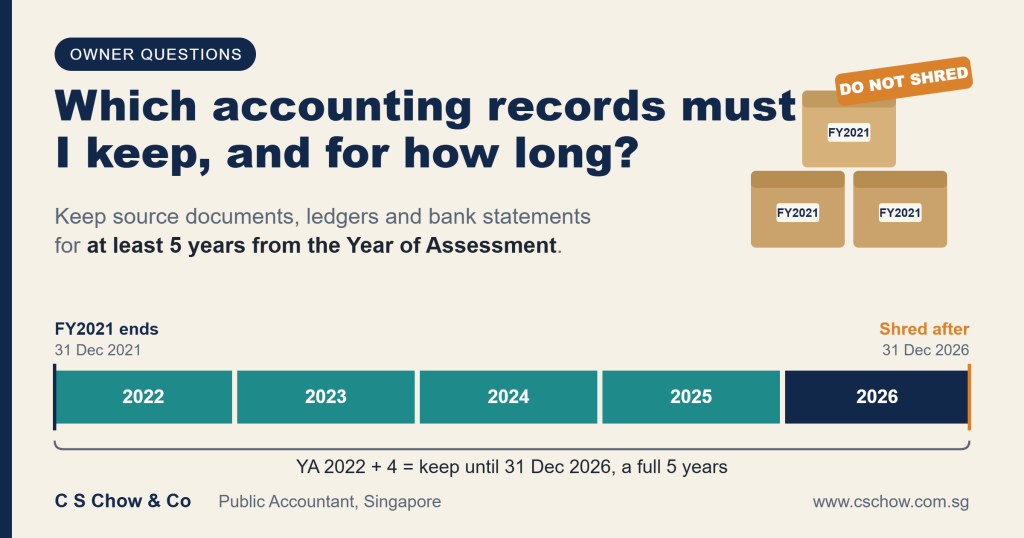
You are clearing the storeroom before your lease ends in December. Four boxes hold invoices from financial year 2021, and the shredder is booked for Friday. Your company closes its books on 31 December, so those papers must stay until 31 December 2026. You have about seven weeks left.
The rule
Your company must keep its source documents, accounting records, schedules and bank statements for at least 5 years from the relevant Year of Assessment (YA). IRAS applies this rule under the Income Tax Act. The records behind your GST returns follow the same 5 years.
The count starts from the YA, not from the day you filed. The YA is the year after your financial year ends, so the clock runs longer than most owners expect.
What to keep
- Sales invoices, supplier invoices, receipts and contracts
- Travel and taxi receipts behind your claims
- Bank statements
- Ledgers and the schedules which summarise your transactions in order
- GST records, if you are registered
- Payroll files. MOM requires employers to keep itemised payslips and employment records for the latest two years. For a former employee, you keep those two years for one year after the person leaves. Salary also supports your tax deduction, so most companies hold payroll with the other records for 5 years.
Bank statements alone fall short. IRAS treats keeping only bank statements as poor record keeping. You must explain every transaction behind your income, expenses and purchases. Paper or electronic copies of source documents both pass.
Worked example: find your destroy-after date
Take the year your financial year ends, add 1 to get the YA, then add 4 to the YA. You keep records until 31 December of the result.
Company A closes its books on 31 December 2021. YA = 2021 + 1 = 2022. Keep until 31 December 2022 + 4 = 2026.
Company B closes its books on 30 June 2026. YA = 2026 + 1 = 2027. Keep until 31 December 2027 + 4 = 2031.
Now price the shortcut. You claimed S$60,000 of expenses in 2021, and the boxes you kept support S$42,000. IRAS disallows the other S$18,000 (60,000 – 42,000). At the 17% rate, S$18,000 of extra chargeable income adds S$3,060 of tax (18,000 x 0.17). Partial exemption lowers this for a small company, so treat S$3,060 as the top end. Add a penalty of up to S$5,000 for the record keeping offence. The worst case reaches S$8,060 (3,060 + 5,000).
Two situations catch owners out
Changing accounting software: you need not move old transactions into the new system. You must still keep and retrieve them for the full 5 years. Export your old ledgers before you cancel the subscription.
Closing the company: if your company is struck off, an officer must make sure the books and papers stay for 5 years after the dissolution date.
What IRAS does
Poor record keeping is an offence under the Income Tax Act and the GST Act. IRAS estimates your revenue and disallows expense claims, capital allowances or GST input tax claims. IRAS also imposes penalties of up to S$5,000, with up to 6 months in prison if you do not pay.
Our accounting service keeps your ledgers and scanned source documents together by year, so you find any record when IRAS asks: https://www.cschow.com.sg/accounting-services-singapore/
Message me your financial year end on WhatsApp at +65 9876 3553 or email henry@cschow.com.sg. I will work out your destroy-after dates with you.
Henry Chow, Public Accountant, C S Chow & Co